

After testing dozens of hosts worldwide, we narrowed the selection to 10 that offer high resource limits, reliable uptime, and features like LiteSpeed servers to ensure the best possible experience for your WordPress hosting needs.
Short on Time? These Are the Best Web Hosts for WordPress Multisite in 2026
-
Hostinger
– All-in-one managed WordPress Multisite hosting with fast NVMe SSD storage and LiteSpeed servers.
- IONOS – A scalable and low-cost Multisite provider perfect for developers and more technical users.
- InterServer – Unlimited shared hosting plan plus cheap cloud VPS ideal for bigger WordPress networks.
What We Look For in the Best Multisite Hosting for WordPress
When looking for the best WordPress Multisite host, there are a few important features I prioritized:
- Plans compatible with WordPress Multisite. Not all hosting plans support WordPress Multisite. For medium to large networks, I recommend cloud, VPS, or dedicated plans with dedicated resources like RAM and CPU cores to handle the extra demands.
- WordPress Multisite support. Managing a Multisite network requires expert technical support. The hosts on my list offer teams experienced in both WordPress and Multisite, ensuring you get the help you need.
- Optimized WordPress performance. Multisite networks need fast, stable hosting. The hosts on my list offer advanced caching, file compression, and high-performance servers. They also offer useful features like database and file optimization solutions.
- Generous resource limits. Multisite setups can be taxing on resources, especially for large or busy networks. I’ve chosen hosts that offer ample storage and bandwidth at competitive prices. It’s also important to check inode limits – going over the allotted limit, even if you still have storage space, can affect your site’s performance.
- Security features. Security is critical for Multisite networks, as one compromised site can affect the whole network. I’ve chosen hosts with robust security features, including free, effective security suites and tools.
Testing Methodology
Our team tested hundreds of hosting providers worldwide by hosting the same real website with each and measuring key performance metrics such as time to first load, largest contentful paint, time to fully load, average uptime over a month, worldwide performance without additional CDN integrations, and more. From a user perspective, we also analyze how easy it is to get started with each host, whether they provide a custom control panel (and if so, how easy is to navigate), and which additional features they offer to improve the user experience.
We then test customer support by personally reaching out to each support team through a variety of channels with questions real customers have. We also consult previous customer reviews to ensure we have a top-down view of the host’s quality. You can learn more about our testing methodology here.
| Host | Best for | Standout Feature | Number of Websites for Multisite | Storage space for Multisite | Starting Price |
|---|---|---|---|---|---|
| Hostinger | Small-to-medium businesses that need high performance | Proprietary user-friendly hPanel and LiteSpeed servers for excellent WordPress performance | 3 – 100 | 20 GB SSD – 300 GB NVMe SSD | $2.49 |
| IONOS | European-based businesses on tight budgets | GDPR-compliant datacenters and proprietary WordPress management hub | Unlimited | 10 GB SSD – Unlimited SSD | $1.00 |
| InterServer | American-based businesses that need unlimited resources | Price-lock guarantee and unlimited resources on all plans | Unlimited | 30 GB SSD – Unlimited HDD | $2.50 |
| HostArmada | Growing networks that want cloud-speed performance with boutique-level support | High-performance, reliable cloud hosting | Unlimited | 15 GB NVMe SSD – 320 GB NVMe SSD | $1.49 |
| Hosting.com | Mid-size businesses that need a reliable all-rounder with no steep learning curve | Turbo plans with impressive page loading speeds for performance-driven Multisites | Unlimited | 10 GB SSD – Unlimited NVMe SSD | $1.99 |
| Liquid Web | Multi-store networks with sites powered WooCommerce | Premium, managed, cloud hosting tailored for e-commerce Multisites | Unlimited | 15 GB SSD – 800 GB SSD | $5.00 |
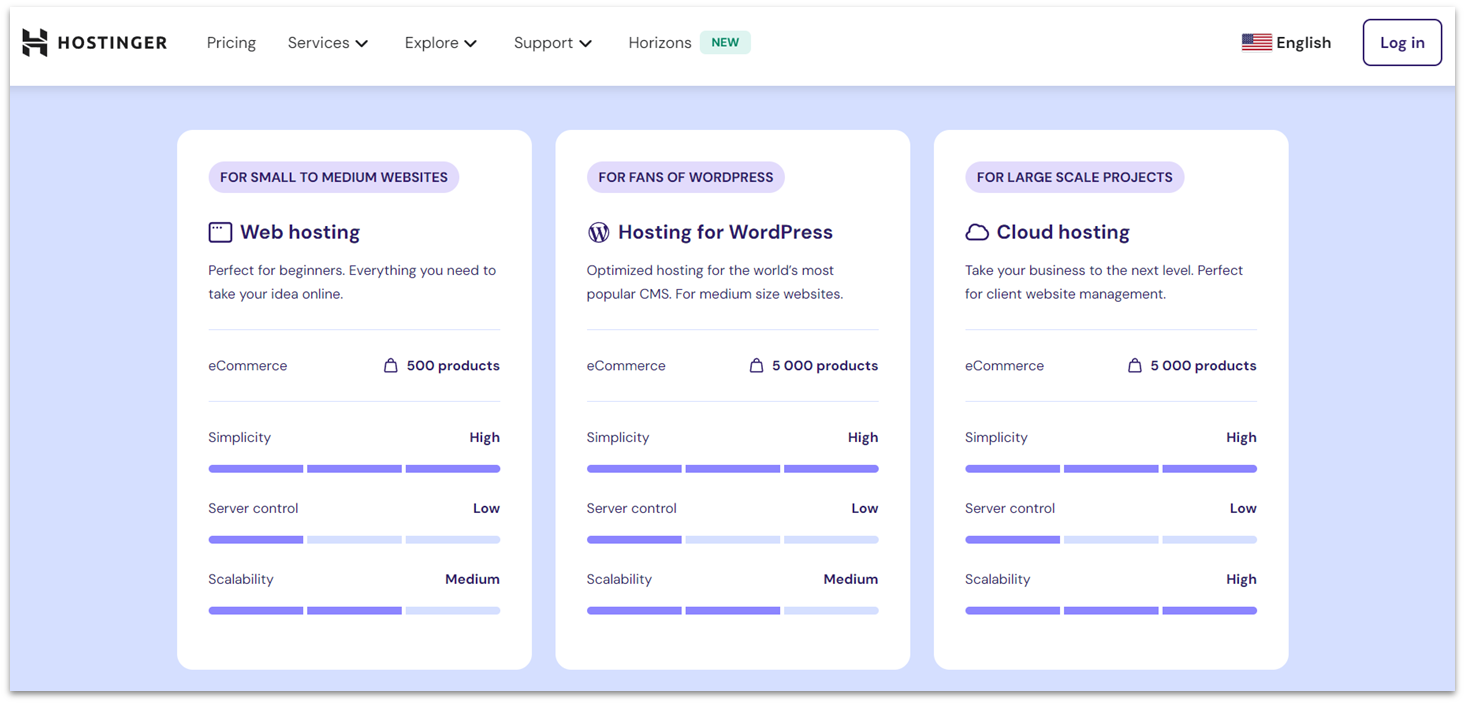
Hostinger offers a mix of affordability and performance for small- to medium-sized Multisite businesses. It includes out-of-the-box optimizations for WordPress, such as LiteSpeed servers, which can improve WordPress site performance up to 5 times, managed WordPress installations, and free weekly migrations. On the Business plan (which we recommend for its 50 website limit) and above, you also get Hostinger’s proprietary WordPress site staging tool, AI agents for WordPress management, the Gutenberg editor, and free CDN integration.
In our tests, Hostinger delivered full-load times as low as 0.8 seconds, 100% uptime over a month of testing (with a 99.9% uptime guarantee), and consistently kept full-load times under 2.5 seconds worldwide for locations far from our server without a CDN installed.
| Best For | Not For |
|---|---|
| ✅ Medium-sized businesses that require high resources ✅ Balance between budget and features ✅ Niche content creators with many related sites |
❌ Very high traffic Multisite networks ❌ Teams that rely heavily on phone support ❌ Power users who need advanced staging workflows |
Pricing
Pros
- AI WordPress website builder. Hostinger offers its advanced AI website builder for free on all shared and cloud plans. It supports Multisite, but you’ll still need to set Multisite up manually in your WordPress admin dashboard.
- Site-building wizard. Hostinger’s WordPress Starter Wizard helps you choose a theme and install essential plugins, giving you a solid foundation for your WordPress sites.
- Free Multisite migrations. You can get unlimited free site migrations on select plans, including Multisite networks mapped out on subfolders or subdomains.
- Easy inode management. You can see your inode usage directly from Hostinger’s hPanel. There’s full transparency here – a pie chart will show you what you’ve used at a glance. If you need a more detailed look, you can access your File Manager and use the Calculate by directory size option to see which file types are taking up the most space.
- Secure WordPress configuration. Hostinger includes an active vulnerability scanner, Cloudflare-protected nameservers, and on-demand backups to help protect your site.
Cons
- Support could use improvement. Though support is effective for simple problems, we found it wasn’t as reliable for more technically complex ones.
- High renewal fees. Hostinger’s prices can increase by up to 5 times the original price after your initial billing period ends.
- Plugin and theme management is still network-wide. There’s no native way to assign or restrict plugins per subsite from the host panel.
To see Hostinger’s full testing results, read our expert Hostinger review.
| Money-back guarantee | 30 days |
|---|---|
| Data center locations | 1 in the US, 4 in Europe, 2 in Asia, 1 in South America |
| Uptime guarantee | 99.9% |
| Starting price | $2.49 |
IONOS offers low-cost unmanaged plans and fully GDPR-compliant datacenters in the EU. Depending on your hosting, you can get SSH or root access, unlimited sites, and even unlimited storage on higher-tiered shared plans. IONOS also offers WordPress-specialized plans with 1 vCPU, 9-20 GB of RAM, a free domain name for a year, a WordPress AI assistant, and automatic updates and virus scanning.
During our tests, IONOS achieved perfect uptime, an “A” score on GTMetrix, and full load times below 1.5 seconds worldwide. On dedicated WordPress plans, IONOS’s inode limit of 262,144 is generous enough for medium-sized Multisite networks.
| Best For | Not For |
|---|---|
| ✅ Europe-based businesses that require GDPR compliance ✅ Developers and sysadmins who require full root access ✅ Technically skilled solopreneurs |
❌ WordPress beginners or non-technical users ❌ Teams expecting proactive WordPress-specific support ❌ White-label dashboard and reseller hosting |
Pricing
Pros
- Proprietary WordPress hub. IONOS’s centralized WP management dashboard lets you monitor, update, and manage all your WordPress installations from a single dashboard.
- Daily backups. IONOS includes free daily backups and stores them for up to six days. Some WordPress plans also include Jetpack backups for free for one year.
- Premium SSLs. Shared plans include a free Wildcard SSL, while WordPress plans offer a free regular SSL with Domain Validation (DV).
- WordPress AI builder. IONOS’ WordPress plans come with a useful addition: a free AI WordPress builder. If you choose this option, you’ll just need to answer a few questions, and the AI builder will generate a website for you in minutes.
- Protected directories for .htaccess. To protect your WordPress Multisite, IONOS’ shared plans allow protected directories. You can set a username and password to prevent unauthorized users from editing or corrupting your core website files.
Cons
- No managed WordPress layer. IONOS doesn’t offer fully-managed WordPress, so core updates, performance tuning, and installation are entirely your responsibility.
- High renewal rates. Though still on the budget-friendly side, IONOS’s pricing rises considerably after the introductory period.
- One website per plan. IONOS only officially supports one website per plan. You can still set up a WordPress Multisite, but you’ll need to do it through a subfolder or subdomain setup.
Check out our detailed IONOS review for more on developer tools.
| Money-back guarantee | 30 days |
|---|---|
| Data center locations | 3 in the US, 6 in Europe |
| Uptime guarantee | 99.9% |
| Starting price | $1.00 |
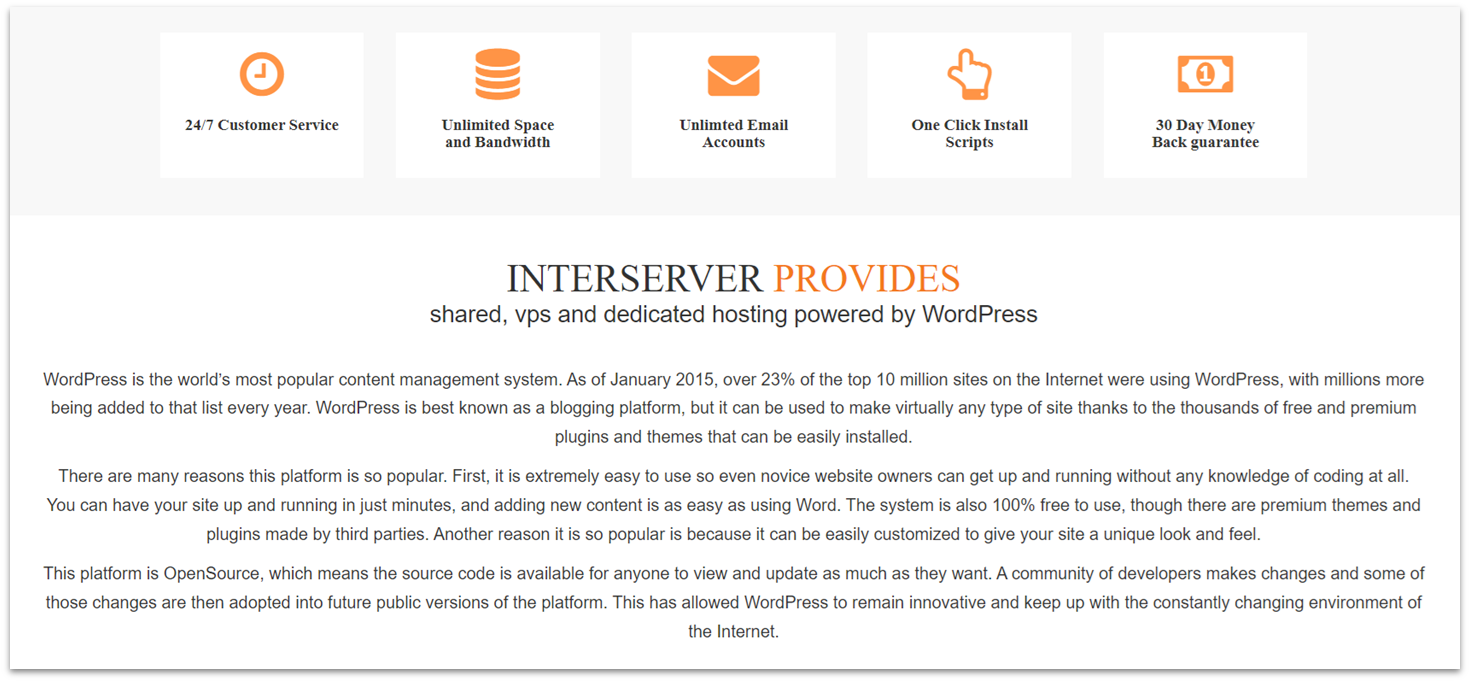
InterServer is a smart pick if you’re running a WordPress Multisite network on a budget. Though you can create unlimited websites with its Standard Web Hosting plans, I recommend opting for a Boost plan, which provides more dedicated RAM, vCPU cores, and higher inode limits. All shared hosting plans also come with unlimited storage space.
InterServer doesn’t offer managed WordPress plans, but all WordPress VPS plans come with out-of-the-box optimization tools and plugins like OPcache for PHP, OpenLiteSpeed, and the Heartbeat Control plugin to monitor resource use. In our tests, InterServer consistently delivered loading speeds below the 2-second mark in North America with 100% uptime. We noticed decent loading times in regions farther away, like South America and the UK.
| Best For | Not For |
|---|---|
| ✅ American-based businesses that need unlimited resources ✅ Predictable, stable month-to-month billing ✅ Multi-tenant platforms with variable traffic |
❌ Businesses based far away from North America ❌ Non-technical users or beginners ❌ Businesses that rely heavily on host-side support for WordPress issues |
Pricing
Pros
- Price-lock guarantee. On Boost plans and above, InterServer offers a complete price-lock guarantee, which ensures your bill doesn’t increase after the first billing period.
- Generous inode limits. Shared plans support up to 400,000 inodes, with Boost upgrades increasing this to 800,000-3.2 million, depending on the tier.
- Choice of control panels. InterServer includes free DirectAdmin with shared and VPS plans, plus Webuzo for VPS plans. You can also add paid panels like cPanel, Plesk, and CloudLinux.
- VM compartments. VPS Multisite networks are isolated in virtual machine compartments for better resource allocation and protection from other users on the server.
- Proprietary security solutions. All plans include InterShield with DDoS protection, malware scanning, and a firewall. If your site becomes compromised, Inter-Insurance covers cleanup and recovery.
Cons
- Only US-based datacenters. InterServer doesn’t offer server locations outside the US, which heavily impacts the performance of sites based outside of North America.
- No free domain included. Unlike most competitors at similar price points, InterServer doesn’t bundle a domain with hosting plans
- No built-in CDN. InterServer requires integrations with third-party content delivery networks to improve your site’s worldwide performance.
See our full InterServer review for more features.
| Money-back guarantee | 30 days (shared plans) |
|---|---|
| Data center locations | 6 in the US |
| Uptime guarantee | 99.9% |
| Starting price | $2.50 |
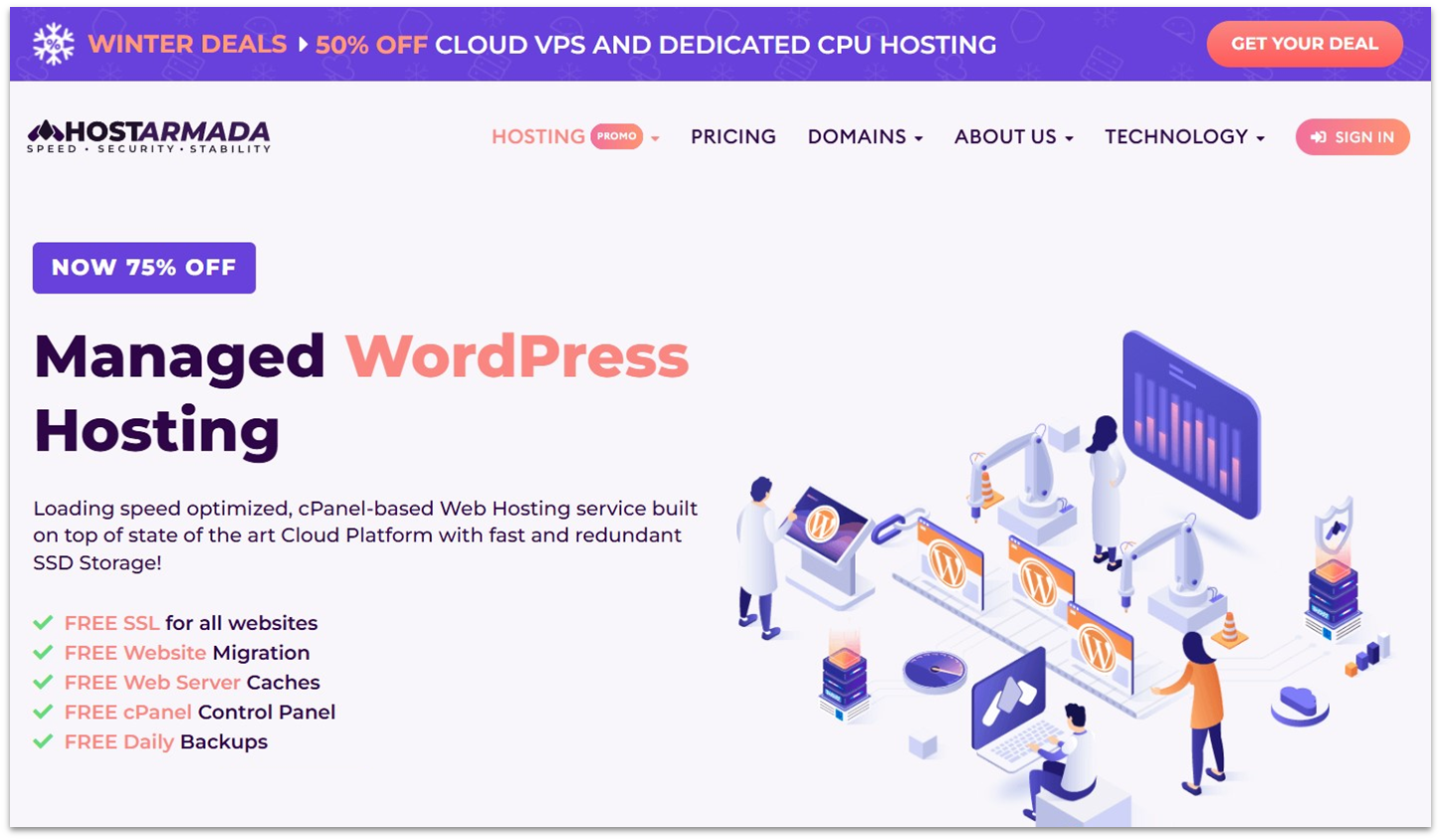
HostArmada offers cloud shared hosting, which combines the benefits of cloud hosting (better isolation and greater resource flexibility) with the pricing of standard shared hosting. The higher-tiered WordPress plans include unlimited websites, free cPanel licenses, and proprietary security tools. All HostArmada plans come with managed features like daily backups, automatic updates, and custom optimizations and site fixes.
HostArmada’s Speed Reaper WordPress plan offers speed optimizations with LiteSpeed servers, dynamic caching, and the latest HTTP/3 protocol. It’s the most expensive shared plan, and these optimizations aren’t available on the others. However, with a guaranteed 6 vCPU cores and 6 GB RAM, it’s also the most powerful shared plan on my list.
| Best For | Not For |
|---|---|
| ✅ Growing agencies and freelancers ✅ Global audiences |
❌ High-volume e-commerce ❌ Developers who require root access or custom server configurations |
Pricing
Pros
- Remote daily backups. HostArmada provides free daily backups on all plans, stored remotely for up to 21 days.
- Dedicated resources. Every plan includes dedicated RAM and CPU cores for stable, reliable performance. Shared hosting starts with 2 cores and 2 GB RAM and scales up to 6 cores and 6 GB RAM. VPS and dedicated servers offer even more power, with up to 16 cores and 32 GB RAM.
- Three layers of firewalls. HostArmada protects your site with Imunify360 network and web application firewalls. It also includes an advanced firewall that uses AI and herd immunity to detect and block complex threats.
- Comprehensive free security suite. Beyond firewalls, HostArmada’s plans include proactive defenses like malware and virus scanning and hardened PHP. You also get brute force protection, 24/7 monitoring, account isolation, CageFS, and more.
- 45-day money-back guarantee. HostArmada offers one of the longest refund windows among web hosts, letting you try the service risk-free for 45 days.
Cons
- Low storage limits. Even on the highest-tiered WordPress plan, you only get 40 GB of NVMe storage, which can easily run out if you host media-heavy Multisites.
- No built-in Redis object caching on standard shared plans. Multisite networks with heavy database usage may need to configure caching solutions manually or upgrade to a VPS.
- No built-in malware removal service. Though HostArmada offers automatic security scanning, it does not include remediation services if malware is found on your sites.
For more WordPress features, head on over to our expert HostArmada review.
| Money-back guarantee | 45 days |
|---|---|
| Data center locations | Web hosting: 3 in the US, 1 in Canada, 3 in Europe, 1 in Australia, and 3 in Asia
VPS: 7 in the US, 1 in Canada, 1 in South America, 7 in Europe, 6 in Asia, and 1 in Australia |
| Uptime guarantee | 99.9% |
| Starting price | $1.49 |
5. Hosting.com: Best for High Performance Without Premium Prices
Hosting.com’s WordPress plans start at $1.99 and include 20-200 GB of NVMe storage, unlimited PHP workers, and a 99.99% uptime guarantee. All WordPress plans come with a managed WordPress installation, and Hosting.com includes a CDN out of the box, so your sites will be optimized for worldwide visitors straight away.
On the security front, every Hosting.com Managed WordPress plan comes with dual firewalls powered by Cloudflare Enterprise and Imunify360, plus continuous malware scanning that automatically quarantines threats. It also automatically applies core WordPress updates and plugin patches to keep your sites protected against new vulnerabilities, while still giving you manual control over major updates from your dashboard.
| Best For | Not For |
|---|---|
| ✅ Those looking for strong performance without flashy extra features ✅ SMBs running content-heavy Multisites |
❌ Solo users looking for a small Multisite network ❌ Teams with complex e-commerce needs |
Pricing
Pros
- Robust security. All plans include Hosting.com’s Perpetual Security suite, with a dual firewall, malware scans, KernelCare, DDoS-proofing, and brute-force attack protection.
- Premium managed plans. Managed WordPress plans run on Hosting.com’s Turbo servers for top-tier speed. These plans also come with guaranteed CPU and RAM resources.
- Softaculous. Hosting.com uses cPanel with the Softaculous app installer, giving you one-click access to hundreds of apps, including WordPress. You can also quickly manage Multisite with Hosting.com’s plugin.
- Site staging. Unlike some hosts that charge extra for this feature, Hosting.com includes a free staging environment with every plan as part of the cPanel and Softaculous suite.
- Clean, intuitive control panel. Hosting.com’s proprietary control panel is user-friendly for non-developer site owners while retaining essential tools for technical users.
Cons
- Limited data center footprint. Although Hosting.com includes a CDN on all plans, there are only a few native data center locations for non-US users.
- Limited managed environment customization. It’s difficult to create custom php.ini files, modify your caching setup, or apply server-level tweaks at will.
- Fewer additional features. Hosting.com has a much thinner offering of proprietary plugins, themes, or features to improve your WordPress experience.
Learn more about Hosting.com in our detailed review.
| Money-back guarantee | 30 days (plus 90-day prorated refund) |
|---|---|
| Data center locations | 2 in the US, 1 in Europe, 1 in Asia |
| Uptime guarantee | 99.9% |
| Starting price | $1.99 |
6. Liquid Web: Best for Multistore Networks With Premium Support
Liquid Web’s managed WordPress plans (formerly Nexcess) offer premium WordPress support at premium prices, with integrated Cloudflare Enterprise, daily backups, unlimited bandwidth, and additional features such as staging sites, WordPress stencils, and web application firewalls. Liquid Web is particularly well-suited for WooCommerce and Adobe Commerce (Magento) operations, thanks to its dedicated plans.
Besides 24/7 support, Liquid Web’s managed e-commerce plans include premium plugins for free, such as Redis Object Cache Pro (valued at $95/year) or the Solid Security Pro suite (valued at $140/year). These additional features help you boost performance and security.
| Best For | Not For |
|---|---|
| ✅ Multiple e-commerce sites ✅ Mid-to-large agencies managing client store networks |
❌ Small businesses on tight budgets ❌ Beginners who value UI simplicity over feature depth |
Pricing
Pros
- Per-site staging environments. Each subsite in the network can have its own staging instance, enabling safe, isolated testing of theme updates, plugin changes, or checkout flow modifications.
- Free auto-scaling. If your sites receive a traffic surge, Liquid Web will temporarily scale resources to maintain performance. You get 24 hours of free auto-scaling per month – beyond that, it’s a small fee per 30-minute increment, or you can upgrade your plan.
- Stage sites with ease. Creating a clone of your site to test development ideas takes only a few clicks in your account dashboard.
- Daily automatic backups. Liquid Web backs up your sites every day and stores the backups off-site for increased redundancy. Your last 30 backups are always available.
- Free store accelerator and performance tools. Liquid Web includes proprietary WooCommerce optimization tools that meaningfully reduce page load times on product and checkout pages across the network.
Cons
- Elevated price. Liquid Web’s managed plans are considerably pricier than any other option on this list.
- No free domain included. Unlike most hosts, Liquid Web doesn’t include a free domain name for the first year of hosting.
- No native Multisite dashboard. Though you can still manage your Multisite through WordPress’s native dashboard, Liquid Web doesn’t offer any native management for Multisites.
Read our expert Liquid Web review for more details.
| Money-back guarantee | 30 days |
|---|---|
| Data center locations | 4 in the US, 3 in Europe, and 1 in Australia |
| Uptime guarantee | 100% |
| Starting price | $17.60 |
Other Notable Web Hosts for WordPress Multisite Networks
7. SiteGround
SiteGround hosts its beginner-friendly plans on Google Cloud’s network and on NGINX and Apache servers, offering excellent site performance and reliable uptime. In addition, these plans offer managed WordPress features to make managing your Multisite network that much easier. One standout feature is the SG Optimizer plugin, which lets you tune up your Multisite setup in one go. However, keep in mind that it comes at a higher price than other alternatives.
| Best For | Not For |
|---|---|
| ✅ Beginners launching their first Multisite network ✅ Bloggers and content creators growing their network |
❌ Tight budgets ❌ Agencies that need white-label tools |
8. Bluehost

Bluehost is one of the few hosts officially endorsed by WordPress. Though it delivered good, but not impressive performance results in our tests, Bluehost stands out for its user-friendliness and affordable pricing. It includes Multisite tools and features like site staging, plugin updates, and a Multisite-compatible AI website builder.
| Best For | Not For |
|---|---|
| ✅ Complete beginners getting started with WordPress Multisite ✅ Budget-conscious small teams |
❌ Larger operations ❌ Media-heavy or high-traffic Multisite networks |
9. Kinsta
Though it comes at a considerable price tag, Kinsta offers robust, reliable managed WordPress hosting built on Google Cloud’s network. In our tests, Kinsta delivered some of the fastest loading times around, along with a perfect 100% uptime.
Kinsta’s dedicated dashboard for WordPress also makes it easy to configure a WordPress Multisite. You also get access to backups, caching, and site staging.
| Best For | Not For |
|---|---|
| ✅ White-label and reseller operations ✅ High-traffic Multisite networks with large, concurrent audiences |
❌ Small teams with restricted budgets ❌ Multisite networks with modest traffic |
10. Cloudways
Cloudways is DigitalOcean’s managed cloud solution. In addition to offering managed DigitalOcean hosting, it also has Vultr, Linode, Amazon Web Services, and Google Cloud plans with features like WordPress migrations, automatic updates and backups, a staging tool, and Multisite DDoS protection.
With a wide range of hosting providers, Cloudways has a vast global network of over 65 data centers worldwide. As part of your service, you even get access to the Cloudflare Enterprise network to up your security. Bear in mind that Cloudways charges a premium for managed services, and you’ll get cheaper hosting if you go directly to any of these platforms.
| Best For | Not For |
|---|---|
| ✅ Tech-savvy developers and DevOps teams ✅ Teams already embedded in a specific cloud ecosystem |
❌ Beginners or non-technical site owners ❌ Teams that need bundled domain registration and email hosting |
How To Set Up Multisite in WordPress
To start, check whether your host offers an automated setup. Some managed WordPress hosts allow you to activate Multisite via the control panel, while many auto-installers let you install WordPress with Multisite enabled. If these options don’t exist, you’re going to have to enable Multisite manually. Don’t worry – it’s a relatively simple process that should only take five to ten minutes.
Step 1: Back Up Your Website Files
As always, perform a full backup before making any changes. If something goes wrong and you don’t have a backup, you could lose your entire website.
Step 2: Locate the File Manager and Access Your Root Directory
To enable Multisite, you’ll need to edit your WordPress installation. If you’re using cPanel or any other control panel like Hostinger’s hpanel, you’ll need to locate the File Manager. To access your files, you can also use an FTP client like FileZilla.
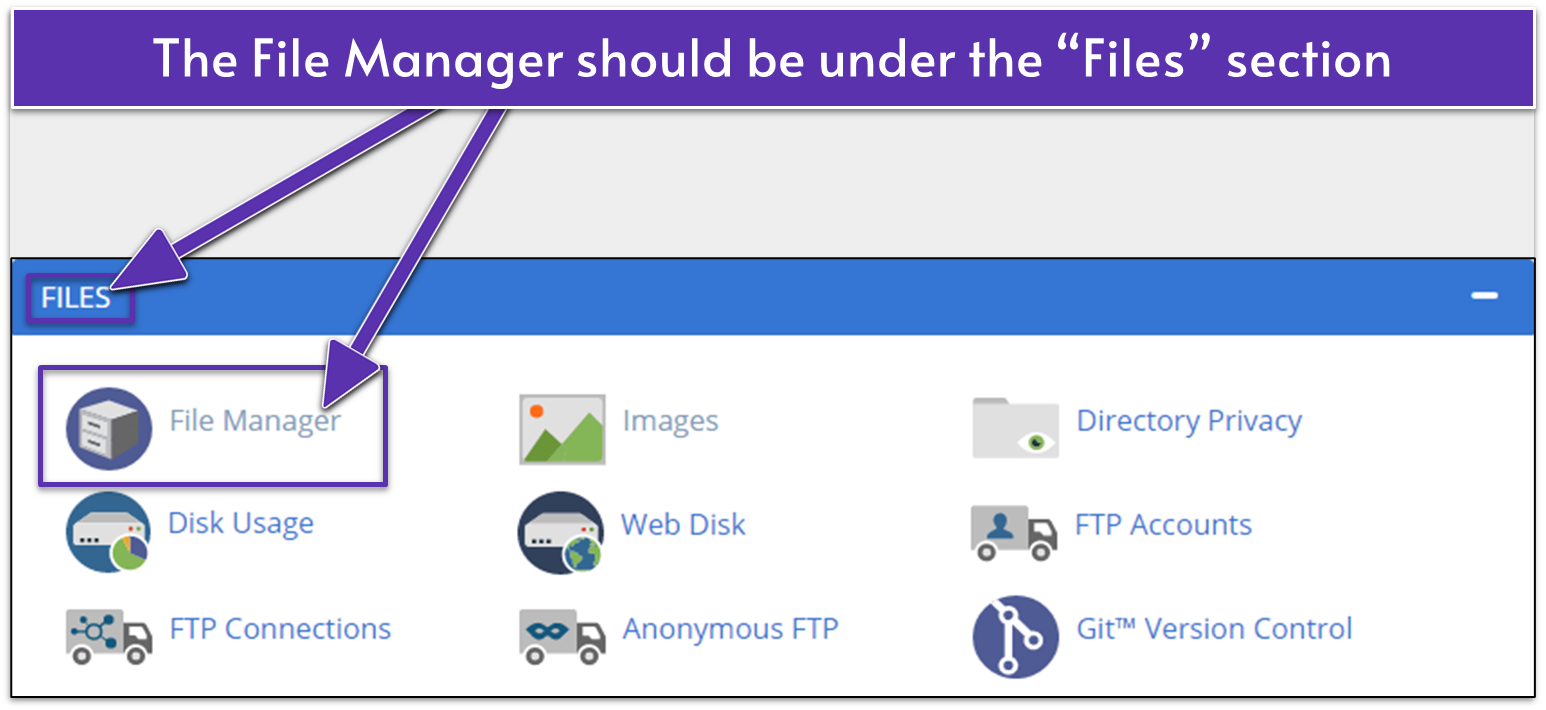
In cPanel, you’ll find your File Manager under the Files section. Navigate to your WordPress root directory – the folder containing subfolders and .php files with “wp” in their names. This will typically be in the “public_html” root directory.
Step 3: Edit Your wp-config.php File
Find the “wp-config.php” file in the root directory and right-click to download it. Once you download the file, open it with a plain text editor (Notepad on Windows or TextEdit on macOS in plain text mode). Do not use Microsoft Word.
On some control panels like hPanel, you can open, edit, and save the file using the control panel interface, which is really handy.
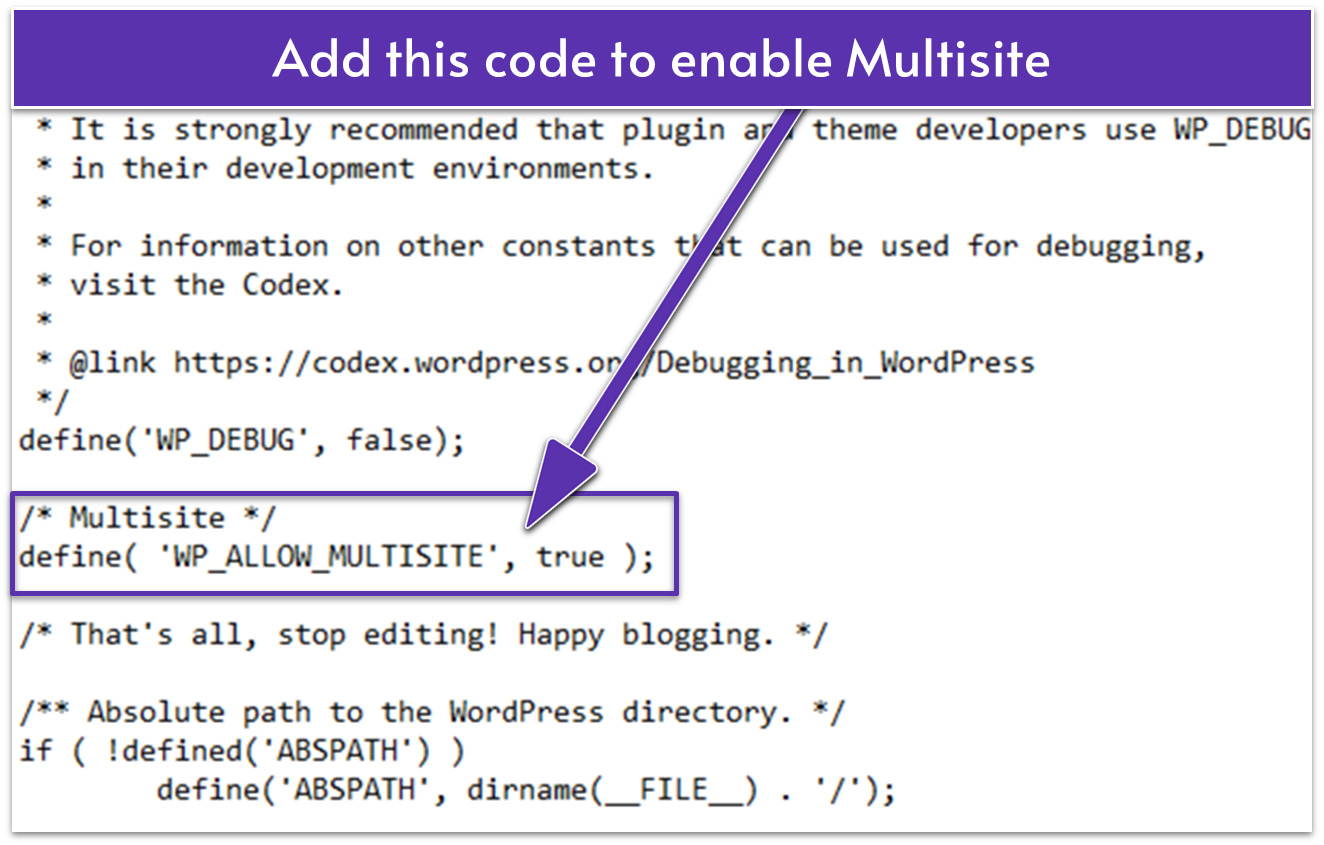
This file will contain some code that might look intimidating, but don’t worry – we’re going to add a few lines near the bottom. Select and copy the following code to your clipboard:
/* Multisite */

define( 'WP_ALLOW_MULTISITE', true );
Paste it just above the comment text that reads “/* That’s all, stop editing! Happy blogging. */”
Then, save the file. All you need to do now is upload the edited version to your site. Make sure you’re in the root folder of your WordPress installation (the folder where we found the wp-config.php file). Next, click Upload on the toolbar at the top of the screen.
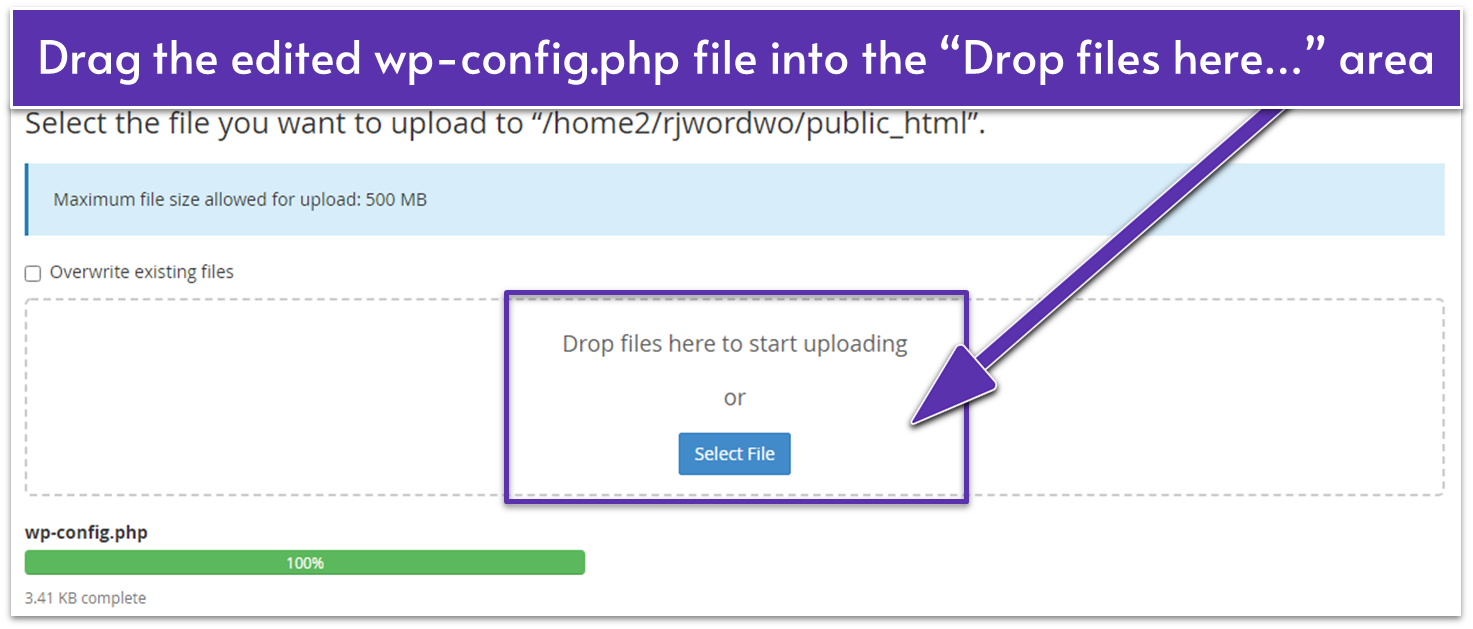
Drag the edited wp-config.php file into the “Drop files here…” area to upload it. When it asks you if you’d like to overwrite the original file, click Yes. You’re done with the File Manager for now, but keep it open as you’ll need it again shortly.
Step 4: Enable and Install Multisite in Your WordPress Admin Dashboard
The next step is to log in to your WordPress site. Before continuing, you’ll need to disable any active plugins to prevent compatibility issues. Go to Plugins, select them all, choose Deactivate from the bulk actions menu, and click Apply.
After you’ve done this, go to Tools in the dashboard menu on the left and click Network Setup in the flyout menu.
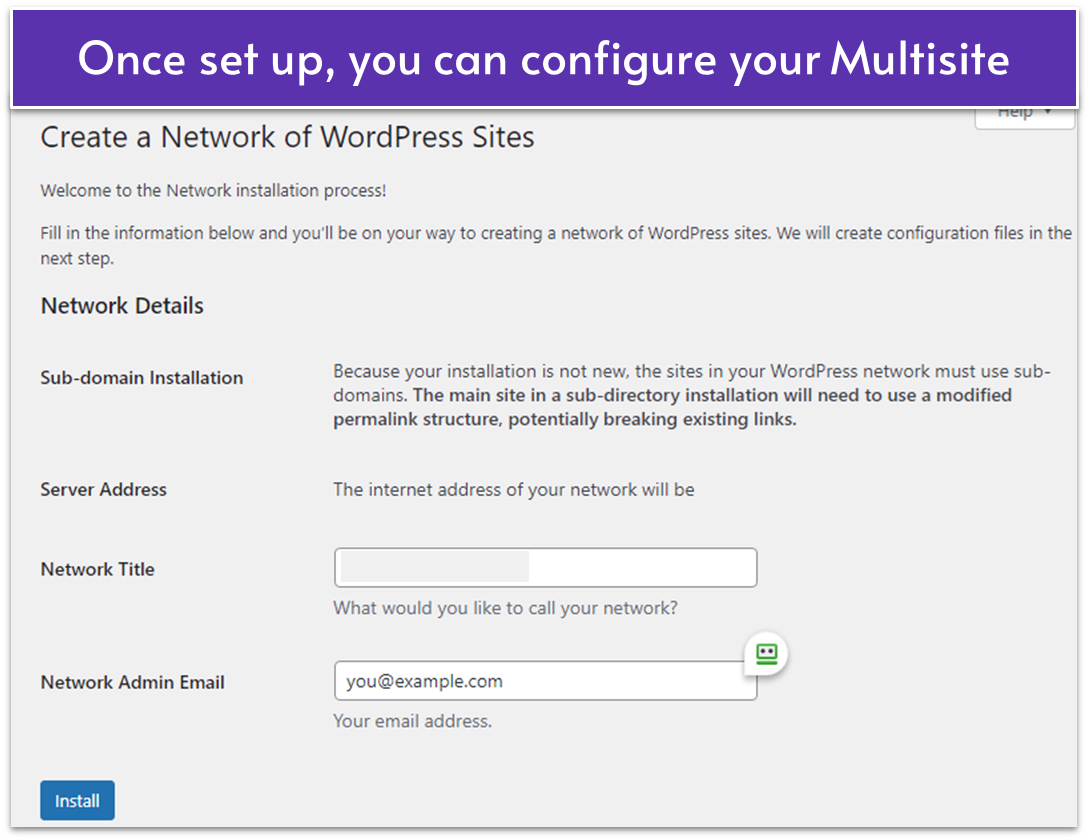
You’ll come to a screen where you can configure your Multisite network. Enter a name for the network and an email address for the network admin. If your WordPress installation is new, you’ll be able to choose a subdirectory network – otherwise, you’ll have to use subdomains instead. Once you’re done, hit Install.
Step 5: Finish Your Multisite Setup… With (A Bit) More Code
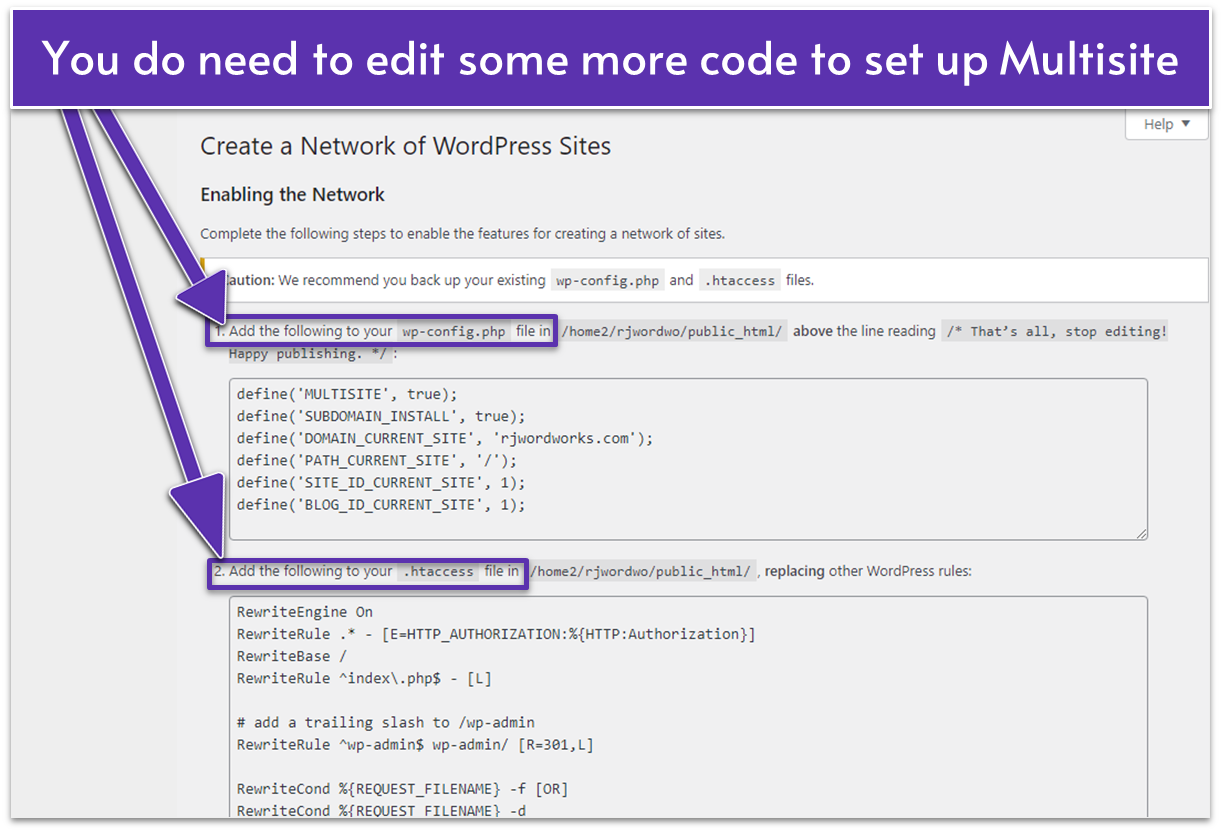
After you finish the installation, WordPress will display two blocks of code. Add the first block to your wp-config.php file. Just like before, paste it right above the line that says “/* That’s all, stop editing! Happy blogging. */”
The second block of code goes in your .htaccess file, which you’ll find in the root directory of your WordPress installation. If you don’t see the .htaccess file, open the Settings menu in the top-right corner of your File Manager and enable Show Hidden Files.
Download the .htaccess file and open it with a plain text editor. Replace the existing WordPress rules with the new code provided. After saving the changes, upload the updated file back to your root directory and overwrite the old version. If you’re using something like hPanel, you can make these text edits directly in the control panel.
When you’ve added both blocks of code, log out of WordPress and then log back in. WordPress Multisite is now activated and ready for configuration!
When WordPress Multisite Becomes a Bad Idea
WordPress Multisite makes it easier to manage multiple similar WordPress sites from a single dashboard. You can oversee plugins, themes, and updates across your entire network without having to log in to each individual site. This can save a lot of time, especially when managing common plugins or themes.
However, WordPress Multisite isn’t the best tool for every situation, and I’d be doing you a disservice if I didn’t make that clear. Before you commit to a Multisite setup, keep in mind some scenarios where Multisite can cause more trouble than it solves:
Plugin Conflicts Get Messy at the Network Level
Multisite applies your plugins to your whole network simultaneously, which can cause unexpected errors. Not all plugins are built with Multisite compatibility in mind. Some behave unpredictably when activated at the network level, others simply don’t work at all, and a small number can cause conflicts that cascade across your entire installation.
There’s also the issue of plugin compatibility. If you require a different set of plugins for each of your subsites, plugins that work just fine on individual sites may clash when installed on the same network.
If you already have multiple WordPress sites or already have in mind some of the plugins you’re going to use, make sure they’re all Multisite compatible and that they don’t cause issues with each other.
Isolated Sites Won’t Work Well With Shared Infrastructure
Multisite is meant to help you manage several similar sites at once. If all your sites share a similar purpose, stack, or set of requirements, then Multisite can be really useful.
However, if sites in your network have wildly different configurations like plugin stacks, hosting requirements, or admin access levels, Multisite’s shared environment can cause critical systems to break.
This goes double for agencies and resellers, where each subsite owner acts independently, since there’s little to no communication when making changes that could “break” the other sites in the network.
Large WooCommerce Stores Require Their Own Installation
Running a WooCommerce store on a Multisite network is technically possible, and for smaller or simpler storefronts, it can work well enough. But as store size, transaction volume, and catalog complexity grow, the shared-database architecture of Multisite starts to work against you.
Large WooCommerce stores generate significant database load: orders, inventory, sessions, and customer records all compound quickly. In a Multisite network, that load sits in a shared database alongside every other subsite, which means a busy store can degrade performance across the entire network. You also lose some of the granular server-level optimization that large WooCommerce installs benefit from, since server-level configuration changes affect all subsites equally.
Which WordPress Multisite Host Is Right for Me?
The best WordPress Multisite host depends on your needs. If you’re running a few low-traffic sites, budget hosting will offer you the best value. For larger or more resource-intensive site networks, a premium solution may be best. All of the hosts on my list provide a good starting point, whether you’re launching a new network or managing a thriving Multisite.
For small-to-medium Multisite networks on a budget, Hostinger is the best option. Its affordable and hard-to-beat WordPress plans include speed-optimized servers, AI-powered tools, and fully managed maintenance.
If you’re comfortable managing things on your own, go with IONOS. Its developer tools and low pricing are ideal for in-house and third-party developers and designers looking to keep costs low and flexibility high.
For larger Multisites, InterServer’s unlimited features on shared hosting and WordPress VPS plans are a great fit. The host also offers lots of beginner-friendly tools and recovery features.