
Welcome to another interview by Website Planet. Bringing you insights on how the best companies are solving the current challenges in their industry, and how they are planning ahead for the future.
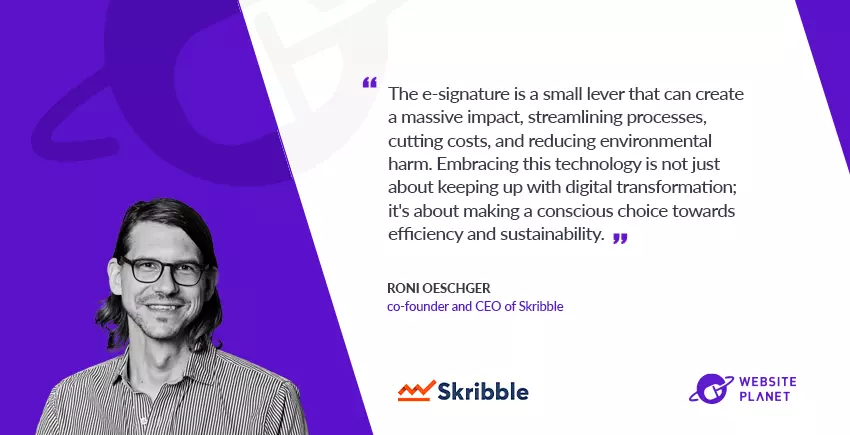
My guest today is Roni Oeschger, co-founder and CEO of Skribble and entrepreneur since the age of 16 with a Master’s degree in Computer Science from ETH Zurich.
We discussed two overlooked facts about eSignatures:
- The multiple reasons why you need them now or eventually later
- Why implementing legally-binding and easy-to-use, efficient digital signatures is harder than it looks
We then looked at the approach to digital signatures at Skribble AG, one of the leading e-signing providers in the DACH region.
Founded in March 2018, it now counts 3,000+ business customers in over 30 countries such as Baloise Group, DATEV, easyJet, SBB, SEG Automotive, leading international auditing and consulting firms as well as law firms.
Handwritten signatures waste money, time and resources
In the e-signature industry, one of the unique challenges we face is the underestimation of the inefficiencies tied to traditional, handwritten signatures. Many individuals and businesses don’t realize the extensive amount of time, money, and natural resources, like paper, that are wasted through manual signing processes. This oversight is particularly relevant because it directly impacts operational efficiency, cost-effectiveness, and environmental sustainability—three pillars that are increasingly critical in today’s world.
? How paper production (which is used for handwritten signatures) causes deforestation, pollution, and greenhouse gas emissions:
- The pulp and paper sector was responsible for just under 2% of all emissions from industry in 2022 (source https://www.iea.org/energy-system/industry/paper).
- The production of one sheet of A4 pulp paper can consume up to 10 litres of water.
- 33–40% of all industrial wood traded globally is used by the pulp and paper industry
Sources:
https://www.earthandanimals.com/advocate/wild-earth/params/post/1278141/deforestation-clearing-the-path-for-wildlife-extinctions#:~:text=A%20horrifying%2050%2C000%20species%20become,vanishing%20at%20an%20alarming%20rate.
https://neo-online.co.uk/how-much-water-is-required-to-make-1-piece-of-a4-paper/
https://www.worldwildlife.org/industries/pulp-and-paper
The reason this issue is often overlooked could be attributed to a ‘that’s how it’s always been done’ mindset. There’s a comfort in familiarity, even if it means sticking to processes that are no longer the best option. This reluctance to change is understandable but also poses a significant barrier to adopting more efficient, secure, and eco-friendly practices.
Another reason is that people tend to unconsciously ignore the amount of work and therefore money put into a handwritten signature. The printing, mailing, scanning, archiving etc. is forgotten when one thinks about the cost of a hand-written signature, so one jumps to the conclusion that a signature costs nothing.
If this challenge isn’t addressed, the implications are multifaceted:
- Operationally, businesses continue to lag, bogged down by slower transaction times and cumbersome paperwork management.
- Financially, the costs associated with the overhead of manual labor of handling physical paper as well as the direct costs of paper, printing, and physical storage can accumulate significantly over time.
- Environmentally, the continued reliance on paper contributes to deforestation and higher carbon footprints. Additionally, the physical transport of documents to the signatories or, in some cases, the transport of the signatories themselves is a contributing factor as well.
The hidden dangers of DIY electronic signatures
Addressing the inefficiencies of traditional signing methods, many turn to DIY digital solutions or competitors offering electronic signatures. However, these approaches often fall short due to a lack of compliance with legal regulations surrounding e-signatures.
Simply pasting an image of your signature into a document doesn’t meet the legal requirements for validity and bindingness, especially for documents that necessitate a qualified electronic signature (QES) involving identity verification.
What is a Qualified Electronic Signature (QES)
A Qualified Electronic Signature (QES) is an Advanced Electronic Signature (AES) that meets specific criteria to ensure its legal validity and security.
According to UK and EU regulations, the QES, the qualified electronic signature (QES) is the most secure type of e-signature. By using a qualified certificate issued by a certified provider, it guarantees a higher level of security than advanced electronic signature and simple electronic signature.
What are the requirements for QES?
Qualified Electronic Signatures (QES) require identity authentication before issuing a digital certificate. When signing in, users must electronically identify themselves to verify their ID. Face-to-face or equivalent ID verification ensure the highest trust level of trust.
- Identity verification of the signer by a qualified trust service provider (QTSP)
- Creation of the signature using a qualified electronic signature creation device (QSCD) that ensures only the signer has control of the private key
- Attachment of a qualified certificate issued by a QTSP to the signature, which links the signer’s identity to the signature
- Cryptographic techniques to protect the integrity of the signed document
The actual challenge lies in educating the market about the necessity of not just digitizing the signature process but ensuring it is legally compliant and secure.
How Skribble makes eSignatures efficient, secure, and legal
To avoid troubles, you need a comprehensive e-signature solution that is not only legally compliant with your local jurisdiction (CH and EU-law) but also secure and efficient. At Skribble, we offer just that – a platform designed to meet the legal standards required for electronic signatures while providing an easy-to-use, secure environment for all your signing needs.
Our platform offers identity verification, which is crucial for documents requiring a qualified electronic signature (QES), while ensuring state-of-the-art encryption and secure storage to protect all documents and signatures from unauthorized access.
Moreover, Skribble is designed to integrate seamlessly with existing workflows, making the transition to digital signatures as smooth as possible. Being a SaaS solution, our users can start right away on all of their devices without the need to install software locally or setting up any servers. Therefore, Skribble also scales easily with our clients’ needs. They can even start with one single user and then add more over time as more of their employees start to benefit from electronic signatures.
Our customers benefit from reduced time, cost, and resource use in the legally-compliant signing process, with the added convenience of signing from anywhere. This adaptability suits remote and hybrid work models perfectly. For instance, a client reported reducing contract signing time from days to minutes, speeding up deals and boosting efficiency. Additionally, the digital signing process cuts down on paper and transport needs, saving costs and supporting sustainability goals.
A look into the future: eIDs and eSignatures will change business
As eIDs becomes more common, expect to see a surge in digitalized processes requiring trust. This is because an eID makes it clear who you’re dealing with online. Consequently, e-signatures will become even more essential, seeing broader use across different sectors.
Moreover, e-signatures aren’t just for signing contracts anymore. They can secure any digital data, including audio files, images, or videos, safeguarding them from tampering and clearly identifying the content’s origin. This feature is a potential remedy to the challenges posed by generative AI, which can easily create convincing but fake digital content. As distinguishing these fakes from reality becomes harder for humans, the role of e-signatures in verifying and protecting digital content grows increasingly important.
In the coming years, the development of e-signatures and eIDs will do more than just cut down on paperwork; they will open up new business opportunities and models. The push towards digitalization will ease cross-border operations, making them faster and more secure. With Europe leading the way, as seen with Estonia’s E-Residency program, digital identities are on the brink of transforming our digital interactions, transactions, and access to public services, enabling a shift to a more connected and efficient global digital ecosystem.
These advancements promise a future where digital transactions and interactions are more streamlined, efficient, and secure, underscoring the vital role of e-signatures and eIDs in building a digitally trusted and efficient world.
What should people do to stay up to date and adapt to these changes? What will you do in this regard?
Individuals and organizations should actively engage in continuous learning and stay informed about technological and regulatory developments in the digital identity space. Subscribing to industry newsletters, attending relevant webinars and conferences, and participating in forums dedicated to digital transformation and cybersecurity are effective ways to keep abreast of the latest trends and innovations.
Organizations, in particular, should consider partnering with technology providers that are at the forefront of digital signature and eID solutions. These partnerships can offer insights into emerging technologies and help integrate these advancements into existing systems seamlessly. Additionally, investing in employee training and development programs can ensure that your workforce is prepared and well-equipped to adapt to these digital shifts.
At Skribble, we are committed to staying at the cutting edge of e-signature and eID technology. We continuously monitor the landscape for new regulations and technological advancements, ensuring our platform evolves to meet the highest standards of security, compliance, and usability. Our clients benefit from this proactive approach through regular updates and enhancements to our services, as well as access to expert advice and support. By choosing Skribble, businesses can ensure they are not only prepared for the future of digital transactions but are also actively shaping it.
Have a company in Switzerland or the EU?
Check out Skribble’s free whitepaper to learn the basics of E-Signing
https://www.skribble.com/en-eu/whitepaper-digital-signature/
? Learn more about Skribble
Website: www.skribble.com
LinkedIn:
- https://linkedin.com/company/skribble-trustshapers
- https://www.linkedin.com/in/ronioeschger/
X: https://twitter.com/skribblehq?