

Hostinger and HostGator are two behemoths in the hosting industry. Boasting affordable, high-performance shared hosting plans for beginners and advanced, state-of-the-art VPS Hosting for experienced users, both hosts make similar promises. But do they deliver similar results?
I wanted to find out for certain which host is better, which is why I ran comprehensive tests and research into both of them. I compared everything from performance, features, and security to customer support and user reviews. All of it with one purpose: to find out for sure which host is worthy of your trust and your money.
To be honest, it wasn’t much of a close fight. In nearly every category, Hostinger showed a significant lead over HostGator. That isn’t to say that the latter isn’t for anyone, but for most users, Hostinger is the clear choice.
So, keep reading to find out exactly how these hosts fared against each other, or sign up for a shared hosting plan with Hostinger today.
1. Plans and Pricing
Hostinger Offers Better Value at Every Price Point
Both Hostinger and HostGator are known for their affordable, entry-level, shared hosting plans. Starting with Hostinger, it offers three cost-effective plans for shared hosting. The Premium plan is great for beginners, with 20 GB of SSD storage, 2 professional mailboxes, and the ability to create up to 3 different websites.
But the real standout is the next level up, Business, which gives you access to 50 websites, 50 GB of NVMe storage, 5 mailboxes per website, and more for just $2.49 each month (if you go for annual billing).
You’ll also get a free domain, free SSL, and free daily backups. Unless you’re on an extremely tight budget, this plan is my recommended pick for a good balance of features and pricing.
HostGator is also famous for its low prices, but each plan is just slightly more expensive than Hostinger’s nearest equivalent (before renewal). HostGator offers four shared hosting plans – Hatchling, Baby, Business, and Pro. Each plan comes with unmetered bandwidth, SSD storage (which is a little slower than Hostinger’s NVMe), and a free domain for the first year.
It’s worth mentioning that these are the prices before your first renewal. Both hosts increase the pricing after your first term is through. Depending on your billing cycle, Hostinger can end up being slightly more expensive after renewal.
That said, the price you’ll pay with Hostinger long-term isn’t much greater than what you’d pay with HostGator, and Hostinger offers better value for your money. Besides offering more storage at every price point, Hostinger comes with a lot of added bonuses like WordPress-optimized plugins, and AI tools for WordPress.
Beyond that, Hostinger also delivers better worldwide performance results at each price point (more on that below). In the end, there’s really no question, Hostinger offers better value overall.
2. Features
Hostinger Offers a More User-Friendly Control Panel
Both Hostinger and HostGator come with the features you’d expect if you’re new to hosting. If you’re especially interested in WordPress, both hosts come with specialized plans for WordPress hosting, which include easy installations, custom plugins, and performance-enhancing tools.
For all-purpose hosting, HostGator uses the classic cPanel, which is the industry-standard dashboard for managing your hosting environment. Meanwhile, Hostinger offers its proprietary hPanel. Not only is Hostinger’s hPanel a lot more intuitive and user-friendly, but it can also do just about anything that cPanel can.
Beyond the classic list of features you should expect from a quality host, Hostinger also offers a selection of unique and useful tools. For starters, Hostinger offers a high-quality website builder with an intuitive drag-and-drop builder, powerful AI tools, and quality templates, which makes it an ideal alternative to a traditional WordPress site.
If you do choose to go down the WordPress route, Hostinger also delivers the better option. Hostinger comes with plenty of WordPress tools such as the LiteSpeed cache for performance, a WordPress vulnerabilities scanner to help pinpoint any security issues or unusual activity, and even a WordPress AI agent on the Business plan and up.
Here’s a side-by-side comparison of the tools offered by both hosts:
| Hostinger | HostGator | |
|---|---|---|
| Types of hosting | Shared, WordPress, VPS, Cloud, and Reseller | Shared, WordPress, VPS, Reseller, and Dedicated Servers |
| Free Domain Name | ✔ | ✔ |
| Free SSL | ✔ | ✔ |
| Number of sites | 1-100 | 10-50 |
| Storage | 20GB SSD – 100 GB NVMe SSD | 10 GB – 50 GB SSD |
| Bandwidth | Unmetered | Unmetered |
| Control Panel | hPanel | cPanel |
| Free CDN | Business plan and above | ✔ |
| Email accounts | 2-100 | Pro email free trial (1 month) |
| Money-back guarantee | 30 days | 30 days |
If you already have a website and are looking to migrate it, then Hostinger also delivers a better overall experience. In the past, HostGator users have reported friction when trying to make use of its “free migrations,” which are only really free during the first 30 days, while Hostinger doesn’t impose similar constraints on migration times.
3. Performance
Hostinger is Faster and More Reliable
Shared hosting slices a server into individual accounts; they’re separate, but share the same underlying server resources between them. There are sometimes performance problems on shared hosting when one site starts to consume resources that its neighbors need.
There’s no way of guarding against this, but HostGator does refer to “low-density servers” on WordPress plans. I’m inferring that it means it limits the number of customers per server, and if so, that should help with your site’s speed and performance. Unfortunately, there’s no real detail to go on.
Hostinger offers plenty of tools to help boost performance, such as LiteSpeed web servers and the associated LSCache optimization plugin. Both give Hostinger a definite edge, and that’s not even mentioning its NVMe SSD storage, which outperforms HostGator’s SSD drives.
The result is a definitive competitive edge for Hostinger. While HostGator isn’t bad, in their in-depth review, my colleague found Hostinger to be one of the fastest shared hosting providers out there.
Both hosts’ uptime guarantees are similar, with cloud hosting providing marginally better uptime promises than other types of hosting. Hostinger also offers datacenter locations across four continents, while HostGator only has locations within the US. That means that if you reside outside the United States, the difference in performance will be even more dramatic.
All in all, Hostinger offers better hardware and software – and it goes to great lengths to ensure its servers are optimized. That’s why it’s the clear winner of this section.
Hostinger is the fastest shared hosting service we’ve tested, and its uptime score was almost perfect. For the full test results, see our in-depth Hostinger review.
HostGator’s performance isn’t bad, although some users have complained about slow speeds and a bit of downtime. Read our full HostGator review to find out what went wrong.
4. Security
HostGator Has a Better Track Record
Both Hostinger and HostGator offer a free security suite to keep your sites and data safe. Each host includes a custom firewall, DDoS protection, and SSL certificates with every plan.
These security measures are average for the shared hosting industry – it’d work fine for a basic low-traffic site, but for mission-critical projects you may wish to tighten up security further with third-party solutions. HostGator offers SiteLock for an ongoing fee, which provides automatic malware scans and protection against bot attacks.
That said, while Hostinger hasn’t always offered the best security in the past, it currently includes an impressive range of built-in security tools, at no extra fee. Hostinger includes its proprietary firewall and malware scanner on all shared hosting plans, which uses machine learning to adapt and remove potential threats on the fly.
When it comes to keeping your information secure, HostGator is at a bit of a disadvantage. While both hosts offer free regular backups, HostGator’s backups aren’t technically “guaranteed” on its terms of service, and customers have reported issues with them in the past. It’s also worth noting that HostGator has a 20 GB backup cap, while Hostinger does not.
Though both hosts offer reliable security, the fact that Hostinger doesn’t use third-party tools and has a more reliable backup policy, means I have to give it the win in this category.
5. Support
HostGator Provides Great Support in Minutes – Hostinger Leaves You Waiting for Hours
Both Hostinger and HostGator offer 24/7 customer support through live-chat. HostGator also offers phone support on more advanced plans, while Hostinger offers an easier system for email support. If you’re more of a self-taught kind of person, both offer high-quality and extensive knowledge bases and tutorials too.
I contacted both HostGator and Hostinger’s customer support teams in order to assess the quality for myself. Let’s start with HostGator.
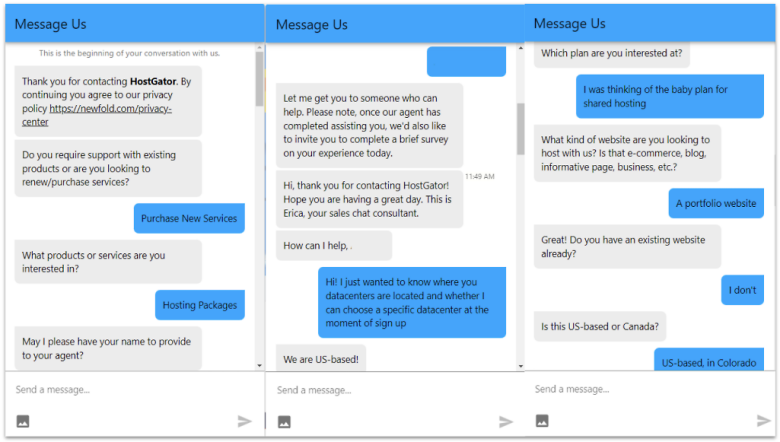
My first question to HostGator was regarding datacenters, and I waited about 10 minutes which is pretty good. The answer itself was direct and concise, though I did get the feeling that my support agent moved on from my question way too quickly in favor of trying to sell me something.
Hostinger’s support was a little slower, but nothing too bad. I did find Hostinger’s live-chat agent more helpful, though a lot of their answers consisted of just handing me links to the knowledgebase.
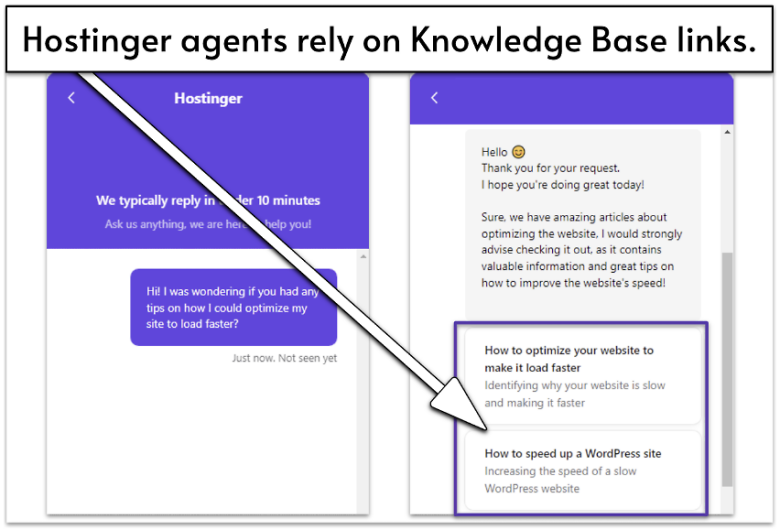
All-in-all, both agents politely addressed my question and provided the information I needed. They both did exactly what I asked and in a timely manner, but neither did anything to “wow” me.
But that’s just my own experience. Other users have reported longer waiting times with Hostinger or sometimes a lack of communication. So, just for that, I have to give this one to HostGator.
Hostinger vs HostGator: There’s a Clear Winner
Although HostGator achieves faster support response times, this factor was insufficient to surpass Hostinger’s superior performance, security, and overall value.
Hostinger made our list of the top ten hosting providers in 2026 for a reason – it’s one of your best options. Unfortunately, it’s more difficult to recommend HostGator.
Here is a side-by-side comparison of Hostinger and HostGator to make the differences clear: