

If GoDaddy’s slow speeds, hidden costs and surprise renewals, or unresponsive support have left you frustrated, you might end up switching to 123 Reg. Many UK users hope that a local provider will offer a more reliable hosting experience. But when you compare the two, it quickly becomes clear that neither delivers the performance, value, or support your website needs.
123 Reg is cheaper than GoDaddy and delivers better loading speeds. But despite this, I still ran into several crucial issues: its plans are missing essential features and it relies on support agents that can’t solve basic problems.
That’s why more UK users are switching to a third option. Hostinger is cheaper overall, offers fast performance thanks to LiteSpeed servers, and comes with its own custom control panel that’s easier to use than cPanel. With data centers in the UK, Hostinger can also deliver better speeds for UK-based audiences. Plus, it’s backed by a 30-day money-back guarantee so you can try it risk-free.
Hostinger gets it right from the start, but if you’re curious who wins the match-up between GoDaddy and 123 Reg, keep on reading for my analysis.
Plans and Pricing
123 Reg Costs Less Than GoDaddy, but It’s No Better
GoDaddy and 123 Reg sell hosting, domain names, and email services, but once you break down what you’re actually paying for, the value disappears fast. I started with 123 Reg because it looked cheaper. Its Economy hosting plan is $3.95/month, while GoDaddy’s Economy plan starts at $5.99/month. You can choose between monthly and yearly billing, which gives you great flexibility (or at least that’s what they want you to think).
Some of the “free” stuff 123 Reg advertises, like an SSL certificate, is only included if you pay for a full year upfront. And even then, there are hidden terms. That free domain they market? It’s only free if it ends in .online, not the .co.uk or .com most people want. That said, the plans do include daily backups and Professional Email Starter for 12 months, which is more comprehensive than what GoDaddy offers.
GoDaddy’s pricing is a little higher, and if you sign up monthly, the price almost triples compared to the annual rate. With a 1-year plan, you get a Standard SSL, Microsoft 365 Email Essentials for 3 months, and Web Security Standard bundle, all of which renew automatically at steep prices unless you cancel in time. If you go monthly, you lose access to all the freebies, which honestly aren’t that great to begin with.
Bottom line: No matter which host you go with, you’re getting 1 website, 25 GB storage, and some “free” extras that tend to vanish unless you commit to a full year. If you ask me, neither is worth buying, especially in 2026, when a free SSL certificate should be a given. If you want clear pricing, better features, and full transparency, Hostinger is the smarter choice.
Features
GoDaddy and 123 Reg Mostly Cover the Basics
Neither GoDaddy nor 123 Reg is particularly generous when it comes to features. Both providers give you the basics: a free domain name, a cPanel dashboard, and unmetered bandwidth. You’ll also get a free SSL certificate, but only for the first year and only if you pay annually.
Some WordPress plans can cost a lot more than standard hosting, so I got curious: what do you get for the higher price? It turns out, not much. 123 Reg includes backups, core updates, malware scans, and a staging environment, but not on the cheapest Basic plan. WooCommerce support and premium extensions are only available with the top-tier Ecommerce plan.
GoDaddy isn’t much better: daily backups, SEO tools, and staging sites only show up on Deluxe plans or higher.
Neither host includes these performance tools or staging features on regular plans, so you’re out of luck (and money) unless you want to do it all yourself. You’ll also have to pay extra if you want a website builder because GoDaddy and 123 Reg treat it as a separate service – and it’s also separate from WordPress, so you won’t be able to take your site with you if you cancel your plan.
One thing 123 Reg does slightly better is migration. Support can transfer your WordPress site for free with a simple one-click migration tool, while GoDaddy requires you to use its automatic hosting migration tool or pay for assistance. That said, both hosts are missing features that even budget competitors include by default these days. GoDaddy doesn’t include daily backups and neither one allows more than one WordPress site per plan.
Here’s how their entry-level plans compare:
| GoDaddy | 123 Reg | |
|---|---|---|
| Hosting types | Shared, managed WordPress, VPS | Shared, managed WordPress, VPS, dedicated server |
| Free domain name | ✔ (1 year) | ✔ (1 year) |
| Free SSL | ✔ (1 year) | ✔ (1 year) |
| Number of websites | 1 to 25 websites | 1 to 50 websites |
| Storage | 25-75 GB NVMe | 25-100 GB SSD |
| Bandwidth | Unmetered | Unmetered |
| Control panel | cPanel | cPanel |
| Free CDN | ✘ (only on Managed WordPress plans) | ✘ (only on Managed WordPress plans) |
| Email accounts | 1 Microsoft 365 account (3-month trial) | 1 to 5 mailboxes (depends on plan) |
| Money-back guarantee | 30 days | 14 days |
Performance
123 Reg Outperforms GoDaddy on Speed and Uptime
GoDaddy is a global provider with servers in North America, Europe, and Asia. In contrast, 123 Reg is a local web host that operates in the UK, which can speed up your site’s loading speeds if your audience is nearby.
GoDaddy uses fast NVMe SSDs on some plans, while 123 Reg uses standard SSDs, which are slower for processing large amounts of data. And as mentioned, neither host includes a content delivery network (CDN) for faster global delivery on their shared hosting plans.
The uptime guarantees aren’t great, either. GoDaddy advertises a 99.9% uptime guarantee, but its policy has strict limits. The compensation is a 5% service credit, and only in specific cases. 123 Reg doesn’t offer any uptime guarantee on shared plans. When you upgrade to a managed WordPress or VPS plan, this changes to account credits equivalent to 5% for VPS and 10–30% for WordPress users – but only for severe downtime and with full documentation.
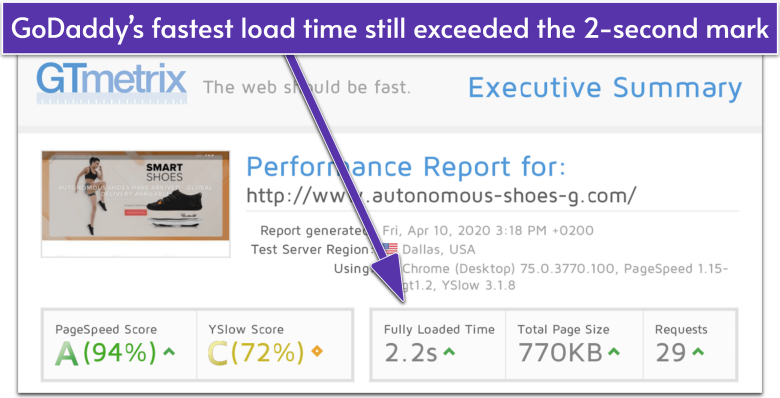
During testing, GoDaddy’s shared hosting averaged a 2.94-second load time on GTmetrix, while global speeds from Sucuri averaged 4.16 seconds. That’s enough to drive visitors away before your homepage even loads.
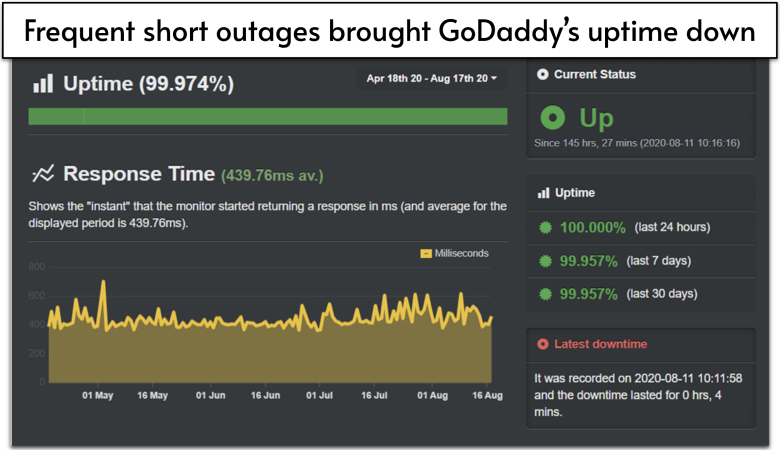
Its uptime was technically passable at 99.974% over four months, but it came with frequent short outages of 3 to 4 minutes every couple of weeks. That adds up. You can see our full GoDaddy review for more.
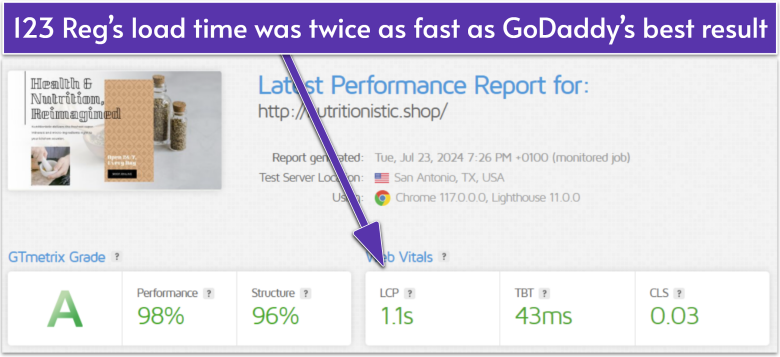
When testing 123 Reg, my colleague couldn’t access the test site for the first 11 days, and support had no explanation. But once she fixed that, the results were surprisingly good. 123 Reg’s load times averaged just 1.1 seconds, and uptime came in at a perfect 100% (dive into the data in our 123 Reg review).
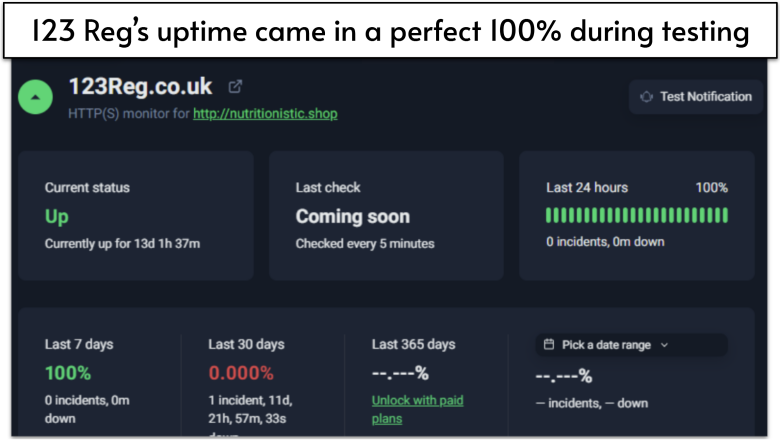
But while 123 Reg delivers stable performance in the UK, it’s still not the fastest host overall. Hostinger holds that title with a 0.875-second average load time in the UK.
Security
123 Reg Includes More by Default Than GoDaddy Does
GoDaddy and 123 Reg include a free SSL certificate with their hosting plans, but built-in security features are otherwise limited. Depending on which one you look at, even the basics like backups, malware protection, and firewalls can require paid upgrades. While these add-ons are technically optional, you’ll need them to run a secure site, especially if you’re handling online payments.
123 Reg includes DDoS protection, 24/7 monitoring, and daily backups on its shared hosting plans at no extra cost. But if you want malware scans, core software updates, or a CDN, you’ll need to choose one of its WordPress hosting plans.
GoDaddy doesn’t include these features by default, but it does offer a 1-month free trial of its Site Security package. This includes malware scanning, uptime monitoring, a Website Application Firewall (WAF), and a CDN. After the trial, it becomes a paid add-on.
For comparison, Hostinger includes standards like DDoS protection and malware scanning, but also throws in WHOIS privacy, Cloudflare-protected nameservers, and a Secure Access Manager for user authentication. These features are available even on its cheapest shared hosting plan, which is only $2.49/month.
Support
GoDaddy Offers 24/7 Support, but 123 Reg Was Faster to Reply
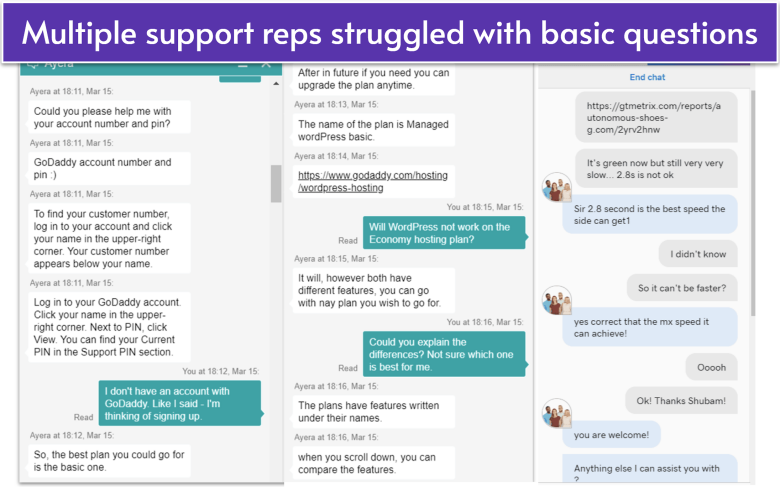
During testing, getting useful answers was almost impossible. GoDaddy and 123 Reg offer support through live chat, phone, and help center. GoDaddy claims its live chat is available 24/7, but it was often offline or came with long wait times. The agent gave copy-pasted responses and couldn’t explain basic things like which plans came with SSL or WordPress support.
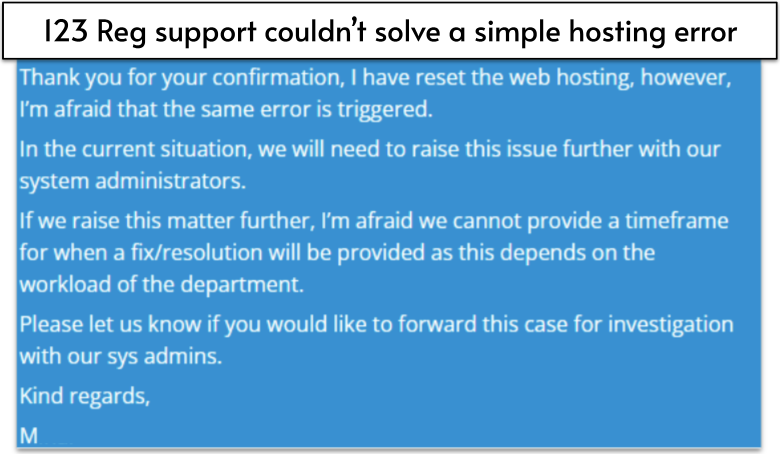
123 Reg’s support was quicker to respond, even with limited hours. Live chat runs from 9:00 a.m. to 7:00 p.m., and phone support is available weekdays from 8:00 a.m. to 10:00 p.m. I got through in minutes, but speed doesn’t always mean better help. One agent couldn’t resolve a basic domain issue and escalated it to tech support. The phone rep then suggested canceling and buying the domain directly from 123 Reg. Classic upsell.
123 Reg’s knowledge base isn’t much better. Its articles often miss key steps or send you to multiple pages just to complete one task. GoDaddy’s help center is bigger, which came in handy. Since the agents couldn’t give clear answers, I had to rely on it to figure things out myself.
GoDaddy vs 123 Reg: No One Wins
If you’re choosing between GoDaddy and 123 Reg, you’re basically picking the lesser of two evils. 123 Reg did perform better in our speed tests and replied to support queries faster, but that alone doesn’t make it a strong option. It still lacks must-haves like a free domain with a popular extension, an SSL certificate on monthly plans, and knowledgeable support.
GoDaddy isn’t much better. It’s slower to respond, costs more overall, and buries essential features under upsells and limited-time free trials with automatic renewals. On the monthly plan, you won’t even get an SSL, email hosting, or malware protection. It’s simply an expensive starter pack with too many limitations.
For most UK users, neither host delivers good value. You’ll get faster performance, lower prices, and more free features with Hostinger, which also made it onto our list of the best web hosting services in 2026.
| GoDaddy | 123 Reg | |
|---|---|---|
| Plans and Pricing | More expensive than 123 Reg, add-ons aren’t clearly laid out until checkout, 30-day money-back guarantee | Slightly cheaper than GoDaddy upfront, but still has hidden terms that affect value, 14-day money-back guarantee |
| Key Features | Unlimited bandwidth, free domain, and free SSL on yearly plans, cPanel | Unlimited bandwidth, free .online domain for 1 year, SSL on yearly plan, cPanel, free email, 14-day money-back guarantee |
| Performance | Global provider with 3 data center locations (North America, Europe, and Asia), 99.9% uptime guarantee, NVMe SSD storage, generally poor loading speeds, periods of downtime during our performance tests | Local provider with data centers in the UK, no uptime guarantee on shared hosting, SSD storage, better performance than GoDaddy |
| Security | Free SSL, basic Site Security add-on includes malware scan, WAF, and CDN (1-month trial only) | Free SSL, DDoS protection, daily backups, 24/7 monitoring included |
| Support | 24/7 support via live chat and phone but hard to reach and unhelpful, even for basic issues | Limited live chat and phone support hours, but faster response times than GoDaddy |
FAQ
Are 123 Reg and GoDaddy the same?
No, 123 Reg and GoDaddy are separate web hosts, but they’re connected. GoDaddy, a US-based provider, acquired 123 Reg’s parent company in 2017. However, 123 Reg still operates independently as a local UK brand with its own platform. The difference is evident: 123 Reg is faster than GoDaddy and provides more reliable hosting.
Why is GoDaddy so expensive after the first year?
GoDaddy uses promotional pricing to look cheaper, but once your first term ends, renewal prices jump significantly. Costs also add up for things like security, backups, and even basic features like email because they’re only available as paid extras (or a free trial on yearly plans). Most of these are pre-selected extras during checkout, so make sure you read the fine print before hitting the submit button.
Which one is more beginner-friendly, 123 Reg or GoDaddy?
Thanks to its cleaner interface and straightforward setup process, 123 Reg is slightly more beginner-friendly than GoDaddy. GoDaddy’s dashboard feels more cluttered and often pushes upsells, which can confuse first-time users. That said, 123 Reg has limited live chat and phone support hours, while GoDaddy advertises 24/7 availability.
Can I transfer my domain from GoDaddy to 123 Reg?
Yes. To start the transfer, unlock your domain from GoDaddy’s dashboard (no support needed unless Domain Protection is on), get the EPP code, and start the transfer. Transfers usually take 5–7 days. Some domains like .uk and .co.uk are free to transfer, but others may incur a small fee.
Do either 123 Reg or GoDaddy include email hosting?
123 Reg includes email hosting with its shared plans, but only for the first year, and not on monthly billing. GoDaddy offers a limited 3-month trial of Microsoft 365 email. In both cases, email is a paid add-on. If you’re looking for a better solution, check out our guide to the best web hosts for email hosting in 2026.
Is there a better option than 123 Reg or GoDaddy?
Hostinger outperforms both with faster loading speeds for UK visitors, straightforward pricing, and responsive support. It also includes free features that 123 Reg and GoDaddy charge extra for, such as automated backups, SSL for all your domains, email marketing, and an AI-powered website builder. This is why Hostinger made the list of the best hosting providers for UK websites in 2026.