
When education is affordable, people assume it can’t be effective.
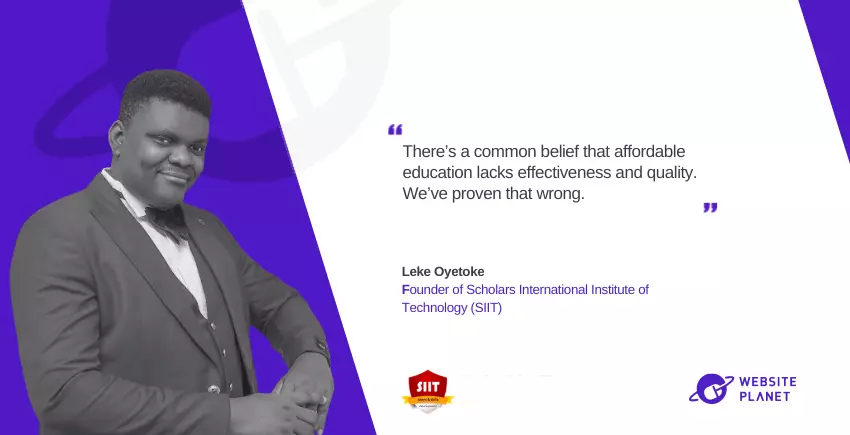
Leke Oyetoke, founder of Scholars International Institute of Technology (SIIT), is proving them wrong.
In this deep dive by Website Planet, we look at how SIIT delivers flexible, self-paced, accredited tech education to over 90,000 learners (many of them career switchers or remote workers), and how this helps building a whole new global workforce that’s skilled, self-sufficient, and untethered from outdated education models.
Affordable Education CAN Be High Quality. SIIT Is The Proof
Brilliant minds in developing countries are still locked out of many tech careers, not because they lack ambition, but because the education system is failing them.
As a computer engineer, IT manager, and tutor in Lagos, Nigeria, Leke Oyetoke saw it firsthand. Students were paying for degrees but leaving school without practical skills.
The worst part? The people who needed training the most couldn’t afford programs that actually delivered outcomes. Those who could afford bootcamps often found themselves burned by high fees and outdated syllabi.
The whole system seemed upside down.
After studying digital marketing and business analytics at Harvard, Oyetoke realized the answer wasn’t another elite, expensive program. It was the opposite.
What if tech education could be self-paced, affordable, and still lead directly to jobs?
What if students could graduate with skills that make them employable, or even self-employable on day one?
That’s why Leke started SIIT (Scholars International Institute of Technology).
A Platform Built for People the System Leaves Behind
SIIT was never meant to compete with elite universities. It was meant to bypass them entirely.
From day one, Oyetoke designed the experience around a different kind of learner: working adults, parents, people with spotty internet or unpredictable schedules, people who couldn’t quit their jobs to attend a live bootcamp—let alone fly across the world.
So he made it:
- 100% self-paced, with modular, mobile-friendly courses
- AI-personalized, adapting to each student’s pace and knowledge gaps
- Hands-on, with real-world projects, virtual internships, and job readiness coaching
- Affordable, with per-module pricing and lifetime access to materials
The result? Over 90,000 learners trained from Africa to Asia to North America, many of them switching careers or landing remote jobs they once thought impossible.
“There’s a common belief that affordable education lacks effectiveness and quality, but this is a misconception, and we’ve proven that with SIIT”
Leke Oyetoke at CIO Views
Breaking the Myth: “Low-Cost Means Low-Quality”
“There’s a common belief that affordable education lacks effectiveness and quality,” says Oyetoke. “But this is a misconception—and we’ve proven that with SIIT.”
To fight the stigma, SIIT pursued dual accreditation from ACTD (U.S.) and QAHE (U.K.), published transparent certification standards, and continuously partnered with global educators to update its curriculum. It also emphasized practical outcomes: students leave with skills they can use to freelance, start businesses, or join the digital workforce immediately.
Recognition followed:
- Top Choice Online Technical Institute – FixThePhoto, 2021
- 67,000+ trained by 2022
- Best Self-Paced Tech Education Entity – Corporate Vision Media, 2023
- Renewed dual accreditation through 2025
Why Self-Paced Is the Future (And Bootcamps Can’t Compete)
The dominant model of tech education—fixed-schedule bootcamps—comes with real tradeoffs:
- Cost: Most U.S. bootcamps cost $13,000–$20,000 upfront
- Time: They demand 40+ hours/week, making them inaccessible for full-time workers or parents
- Relevance: Curricula are updated infrequently, making them stale in fast-moving industries
- Access: Many run live sessions in single time zones, excluding global learners
Self-paced learning flips that.
Students can start anytime, study anywhere, skip what they know, and focus on what they don’t. The best platforms (like SIIT) use AI to adapt content based on industry changes and student performance. Students learn efficiently, affordably, and in sync with the market.
And unlike bootcamps, SIIT doesn’t just teach people how to code. It teaches them how to earn.
What’s Next: 5 Million Students, Rural Tech Hubs, and a Global Workforce Shift
Oyetoke’s next goal? Train 5 million students globally.
That’s not just a vanity metric. He plans to launch in-person bootcamps and tech centers in underserved rural regions, places where even internet access is spotty. The goal is to bring the same opportunity he found in Harvard dorms and Lagos offices to kids in villages and remote towns.
Because SIIT isn’t just a platform.
It’s a bet that global tech talent doesn’t need to be taught differently—it just needs to be reached differently.
Want to bring flexible, career-ready tech training to your community?
Learn more about how Leke Oyetoke and SIIT build future-ready skills wherever you are.
LinkedIn: https://www.linkedin.com/in/lekeoyetoke/
Website: https://siitgo.com